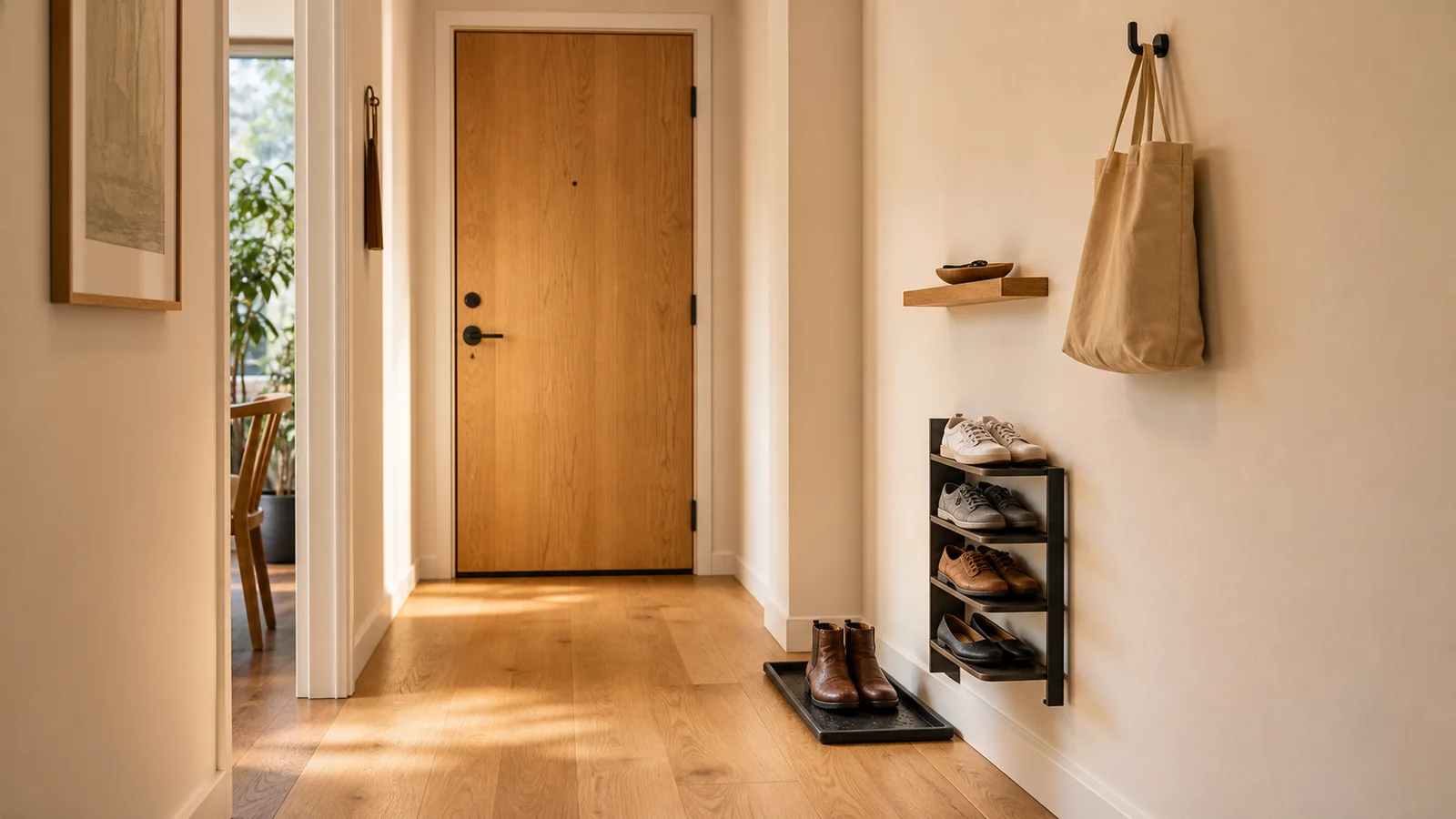
A shoe rack can fit the wall and still fail the room. The front door hits it. The walkway becomes a sidestep. Wet sneakers go into a closed cabinet. Or a tall unit arrives with anchoring instructions the lease does not allow you to follow.
The useful measurement is not the empty wall’s width. It is the space left after the door opens and people walk through.
Measure that clear path first. Then choose the shallowest storage method that holds the everyday shoes your household actually uses.
The short answer
Outline the proposed organizer on the floor with painter’s tape or flattened cardboard. Open the door fully. Carry a bag through the entry. Test the route with every mobility aid, stroller or pet gate that normally uses it.
Then choose by front-to-back footprint:
- use a compatible over-door organizer when there is no safe floor zone;
- use a low rack around 6 inches deep for a few daily pairs;
- use a wall-mounted cabinet around 7 inches deep when fastening is allowed;
- use a narrow bench around 7 1/2 inches deep when sitting to put on shoes matters;
- use an 11-inch cabinet when you need closed storage and can anchor it;
- use a 12- to 13-inch open rack when access and drying matter more than hiding shoes.
A narrower product is not automatically safer. Door operation, stability, wet-shoe handling and the number of pairs all matter.
Map the entryway while the door is moving
Find the narrowest clear route
Open the door through its full swing. Measure the tightest point between the moving door and the opposite wall, railing, furniture or stair edge. Repeat with the door partly open because that may create the narrowest moment.
NFPA advises households to inspect all possible exits and make sure escape routes are clear and doors and windows open easily. Treat that as the nonnegotiable boundary. Shoe storage should not turn a normal exit into an obstacle course.
Do not rely on a universal hallway-width number from an article. Building rules, doors and household needs vary. Preserve the route your home requires and check local or lease requirements when they apply.
Mark the operating space, not just the cabinet
A tilt-out compartment needs room to open. A bench needs knee and foot space in front. An over-door organizer adds loaded thickness to the door. A rack beside the hinges may fit while the door is closed and collide when it opens.
Mark the published footprint, then add the space needed to use it. Live with the outline for a day before ordering anything. If people step on it, catch a bag on it or move around it sideways, the product is too deep for that spot.
Check baseboards, vents and trim
Measure at floor level and again above the baseboard. A cabinet may stand away from the wall even when the listed depth looks acceptable. Keep heating and return vents open. Note outlets, switches and door trim that a tall unit could cover.
Count the shoes that deserve entryway space
Count daily shoes by pair, not by person. A two-person household with work shoes, walking shoes, slippers and seasonal boots can need more entryway capacity than a larger household that rotates one pair each.
Give the entrance a firm everyday limit. Store special-occasion and off-season footwear in a closet, under-bed container or another suitable dry area. Entryway storage works better as a landing zone than as the entire shoe collection.
Measure the largest everyday pair. Deep athletic shoes, high-tops and boots may use more room than a manufacturer’s approximate pair count suggests. A cabinet that claims eight pairs can hold fewer when the footwear is bulky.
Compare the main storage methods
An over-door organizer saves floor space but asks more of the door. The hooks, top gap, hinges, trim and loaded pockets all have to cooperate.
A low open rack is simple and easy to inspect. It leaves shoes visible and needs a tray if footwear comes in wet or muddy.
A wall-mounted tilt-out cabinet can be very shallow. It is useful only when the required fasteners suit the wall and the installation is allowed.
A shoe bench combines a seat with limited storage. It can help someone who sits to tie shoes, but its usable depth includes the person’s feet and knees while seated.
A taller closed cabinet hides more pairs. It usually needs anchoring and may not accept bulky shoes as efficiently as an open rack.
A deeper open rack takes more walkway space but makes shoes easier to see, remove and dry. It is often the honest choice for wet climates if the measured route can spare the depth.
Six documented options for different depths
Disclosure: This is a research-led guide, not a hands-on product test. Well Walked Finds did not physically test these products. We checked specifications against current first-party Target, IKEA and Yamazaki Home pages on July 29, 2026.
No floor footprint: Brightroom 24-Pocket Over-the-Door Organizer
May suit: an interior closet or bedroom door near the entry when no floor rectangle is available.
Target describes this organizer as 22 inches wide with 24 pockets, mesh panels for airflow and an over-door installation. The main fabric uses at least 75 percent recycled polyester.
The product page did not publish a maximum door thickness. That missing measurement is important. Check the hook fit, top gap, hinges, trim, handle and loaded pocket depth. The door should still open, close and latch without scraping or force.
Do not hang it on the home’s primary exit if it interferes with normal door operation. An interior door is the better candidate.
About 6 inches deep: Yamazaki Home Line Expandable Shoe Rack
May suit: a very shallow strip along the wall where a fixed-width rack would waste space.
Yamazaki lists the steel rack at 5.91 inches front to back, 14.96 inches wide in its compact position and 5.91 inches high. It expands from 15 to 27.25 inches wide. The manufacturer says it holds four to eight shoes and limits the tier to 12 pounds.
This is a low landing rack, not a bench. It also does not contain water or grit. Use a washable tray underneath when shoes may be damp, and keep the expanded width out of the door swing.
7 1/8 inches deep: IKEA TRONES Shoe/Storage Cabinet
May suit: a narrow wall where closed storage is useful and permanent wall fastening is permitted.
Each polypropylene cabinet is 20 1/2 inches wide, 7 1/8 inches deep and 15 3/8 inches high. IKEA sells the white version as a two-pack and says each cabinet holds approximately four pairs. Units can be installed side by side or stacked.
IKEA also states that these cabinets must be secured to the wall and that the correct fastener depends on the wall material. That requirement rules TRONES out when a renter cannot obtain permission or cannot install an appropriate fastener. Do not treat its shallow depth as permission to lean it against the wall.
7.48 inches deep: Yamazaki Home Tower Shoe Organizer and Bench
May suit: one or two people who need a compact place to sit and keep four daily pairs.
The white steel-and-wood bench is 7.48 inches front to back, 18.9 inches wide and 18.11 inches high. Yamazaki lists a 220-pound seat limit, a 4.4-pound shelf limit and capacity for four pairs. No assembly is listed.
The bench is narrow, but sitting down temporarily uses more space than the furniture footprint. Test the entry with a chair or box at the same height and depth. There should be room for feet and knees without entering the door swing or forcing another person into a blocked route.
The four-pair limit makes this a daily-use station, not whole-house shoe storage.
11 inches deep: IKEA BISSA Two-Compartment Shoe Cabinet
May suit: a household that wants closed storage for several everyday pairs and has an anchorable wall.
BISSA is 19 1/4 inches wide, 11 inches deep and 36 5/8 inches high. IKEA lists approximate capacity at eight pairs. The compartment dividers can be moved or removed, the back has a baseboard cutout and the cabinet is designed with ventilation.
This is a tall, narrow cabinet. IKEA says it must be fastened to the wall through its predrilled holes with fasteners suited to the wall. If that installation is not allowed, choose a lower freestanding option instead.
Measure your largest shoes before relying on the approximate pair count. Thick soles, high-tops and boots may not fit the same way as low shoes.
12 5/8 inches deep: IKEA TJUSIG Shoe Rack
May suit: a wider entry that can spare more depth for open, accessible storage.
The rack is 31 1/8 inches wide, 12 5/8 inches deep and 14 5/8 inches high. IKEA describes painted solid wood rails and legs with galvanized and stainless steel tubes. Approximate capacity is six pairs.
Two racks can be stacked with the included connection hardware, but begin with one. A second level adds height, load and visual bulk. Follow the assembly instructions rather than improvising a stack.
The open construction makes it easier to see and air shoes, but a tray is still needed for water, salt or mud. The 31 1/8-inch width may be the limiting measurement in a small entry.
Give wet shoes a separate landing spot
Do not put dripping shoes straight into a closed cabinet. EPA’s general mold-prevention guidance centers on moisture control and drying wet areas promptly. Applied to an entryway, the sensible setup is a washable boot tray or mat where wet footwear can drain and dry before moving into closed storage.
Keep the tray fully within the measured storage zone. Wipe up water that escapes it. Clean tracked salt or grit before it abrades the floor. If the entry stays damp or smells musty, solve the moisture source rather than hiding it inside furniture.
An open rack can improve airflow, but it does not make standing water harmless. Closed storage can look calmer, but it should receive dry shoes.
Anchoring is part of the product’s footprint
CPSC advises consumers to follow manufacturer instructions for securing furniture and to anchor top-heavy pieces. Both IKEA closed cabinets in this guide require wall fastening.
Before buying, identify the wall material and read the assembly document. Check the lease or ask the property owner when permission is required. The safe alternatives to an unapproved anchor are a different product, a different location or written permission. Skipping the restraint is not a renter-friendly shortcut.
Keep tempting objects off the top of tall shoe cabinets when children live in or visit the home. Do not allow climbing, hanging from doors or pulling out multiple compartments at once.
Set up a small daily system
Give each household member a realistic number of entryway pairs. Put the most-used pair in the easiest position. Move the rest to secondary storage.
Use a tray for wet shoes and an open slot for the pair that is currently drying. Once dry, return it to the assigned rack or cabinet. This keeps the entire entry from becoming the drying zone.
For the first week, watch what lands beside the organizer instead of inside it. A pile next to an empty rack often signals the wrong shelf height, a difficult door, inadequate boot space or too many assigned pairs. Fix that friction before adding another organizer.
Recheck wall fasteners, connections and level feet according to the manufacturer’s instructions. Stop using a unit that shifts, leans, cracks or interferes with the door.
What to skip
Skip any organizer that overlaps the door swing, narrows a necessary escape route or creates a trip edge at the stairs.
Skip a tall cabinet when the required anchoring is impossible or not permitted. Its approximate capacity does not justify an unsafe installation.
Skip copied marketplace racks with unclear dimensions, seller identity or instructions. A photo of a narrow hallway is not a measurement.
Skip static shoe cubbies until you measure your largest everyday pair. Small cubes can turn adult shoes sideways and use more width than expected.
Skip upholstered closed benches for routinely wet shoes unless the materials and cleaning instructions support that use. A washable tray plus an open drying position is easier to maintain.
Skip storing the entire household collection at the door. A small entry works better when it handles today’s shoes rather than every season.
Frequently asked questions
How deep should shoe storage be in a narrow entryway?
There is no single safe depth. Start with the clear route and door swing, then subtract the operating space needed to open, sit at or load the product. In this guide, documented examples range from about 6 to 12 5/8 inches deep, but even the shallowest one can be wrong for a tight exit.
Is a tilt-out shoe cabinet good for renters?
It can use little floor depth, but many tilt-out cabinets require wall fastening. TRONES and BISSA both do. A renter should use them only when the lease, wall and correct hardware allow the required installation.
Can wet shoes go in a closed cabinet?
Let them drain and dry on a washable tray or open rack first. Closed storage is better for dry footwear. Address standing water or persistent dampness instead of closing it out of sight.
How many shoes should stay by the door?
Keep the pairs used most days plus a drying position. The exact number depends on the household, but the entryway should not become long-term storage for off-season and occasional footwear.
Are over-door shoe organizers safe on every door?
No. Check door thickness, top clearance, hinges, trim, handle position, loaded depth and full operation. Do not use one where it prevents an exit door or interior door from opening, closing or latching normally.
Our research approach
We began with recurring entryway-shoe clutter documented in independently indexed sources, then compared mechanisms by their front-to-back footprint. We checked dimensions, materials, installation instructions, capacity statements and current destination status against first-party product pages.
We excluded a six-tier rack whose rendered first-party page showed it as sold out, decorative benches without documented seat limits and generic marketplace products with weaker seller or measurement evidence. Product pages can change, so remeasure the space and read the current instructions before buying.
Sources
- NFPA: How to make a home fire escape plan
- U.S. Consumer Product Safety Commission: AnchorIt.gov
- U.S. EPA: Mold prevention and moisture control
- Brightroom 24-Pocket Over-the-Door Shoe Organizer
- Yamazaki Home Line Expandable Shoe Rack
- IKEA TRONES Shoe/Storage Cabinet
- Yamazaki Home Tower Shoe Organizer and Bench
- IKEA BISSA Shoe Cabinet
- IKEA TJUSIG Shoe Rack
Related guidance
Continue with the Well Walked Finds Home Organization hub. If the shoes belong in a rental closet rather than the entry, use our renter-friendly tiny-closet storage guide. The same measure-first approach also helps with organizing deep pantry shelves and working around pipes under a sink.