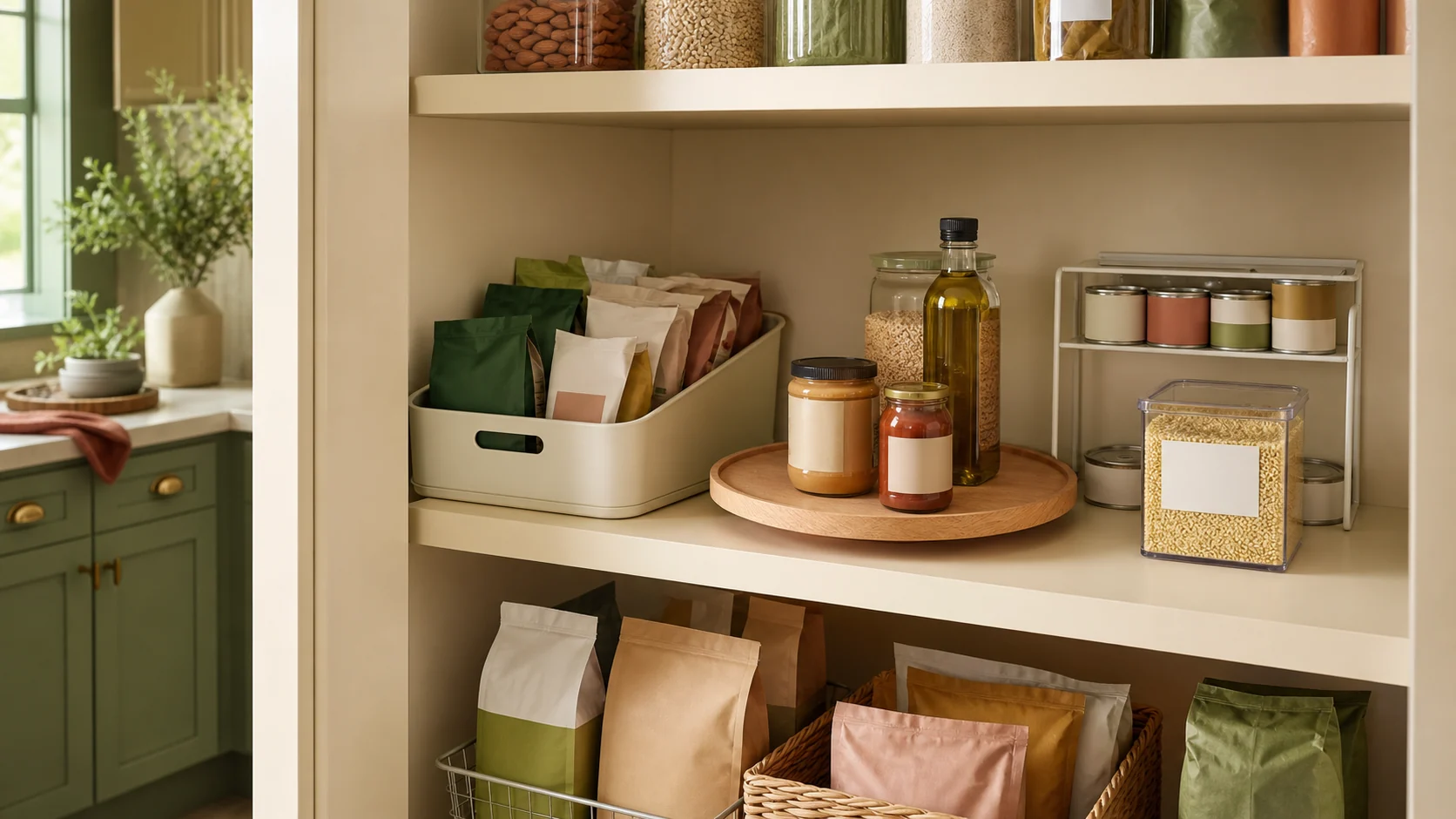
A deep pantry shelf looks generous until three bags of pasta hide behind the cereal and you buy a fourth jar of something you already own.
The problem is not a lack of containers. It is retrieval. If you cannot see an item, pull its whole group forward, or reach it without unloading the shelf, that back half becomes a storage blind spot.
A useful setup gives every category a simple motion: pull, spin, tier, or decant. Measure first, choose the motion that fits the food, and leave enough open space to put groceries away without rebuilding the pantry every week.
The short answer
Empty one shelf at a time. Measure its clear width, usable depth and height, including the narrowest part of the door opening. Put everyday food between waist and eye level when possible. Keep heavy bottles and bulk packages lower.
Then match the organizer to the retrieval job:
- use a long bin when you want to pull an entire category forward;
- use a turntable for bottles, jars and cans that can rotate safely;
- use a riser when short items disappear behind one another;
- use a pull-out basket when the shelf is tall enough and the door opens wide enough;
- decant only the staples you refill often and can label properly.
Do not buy a matching set for the whole pantry yet. Test one shelf for a week. The wrong organizer can make a deep shelf hold less while hiding just as much.
Start with an inventory, not a shopping cart
Take everything off one shelf and group it by use: breakfast, baking, weeknight meals, snacks, drinks, backstock, or whatever reflects how your household cooks. Combine exact duplicates. Put open packages together and set aside anything damaged or showing spoilage.
This step usually reveals the real problem. Sometimes the shelf is too deep. Sometimes one category has spread across three shelves. Sometimes five partly used packages are taking the space of two.
Keep original packaging when it carries cooking directions, allergen information, storage instructions, a lot code, or a date you will need later. If you decant a dry staple, transfer the information you rely on. A container label that only says “flour” is not enough if two people in the household need to distinguish ingredients.
USDA explains that most calendar dates on food communicate quality rather than safety; infant formula is the important stated exception. A “Best If Used By” date is not automatically a discard date. Keep the original date information, follow the package’s storage directions, and use the USDA FoodKeeper when you need product-specific storage guidance.
Measure the shelf as you use it
Write down these numbers before buying anything:
- Clear shelf width. Measure between walls, trim, shelf supports and door hardware.
- Usable depth. Measure from the front edge to the back, then subtract anything that prevents a bin or basket from moving straight out.
- Clear height. Measure to the shelf above, including any lip or frame at the opening.
- Door opening. A wide organizer inside the pantry is useless if it cannot pass through the opening.
- Reach height. Note which shelves can be reached safely without stretching or lifting a loaded bin overhead.
- Largest package. Measure the cereal box, flour bag, oil bottle or bulk item that must fit in each zone.
Quick measurement worksheet
- Shelf: _____
- Clear width: _____
- Usable depth: _____
- Clear height: _____
- Narrowest door opening: _____
- Largest package: _____ W x _____ D x _____ H
- Intended motion: pull / spin / tier / decant
- Can the loaded organizer come out level: yes / no
- Can every label or category be seen from the front: yes / no
If the last two answers are no, change the layout before buying.
Choose by retrieval motion
Pull: one category comes forward together
A pull bin works well for packets, snacks, baking supplies and duplicate jars. The bin becomes a movable shelf. Pull it out, take what you need, and return the whole category.
Match the bin depth to the shelf without assuming that “deep” is always better. A bin that nearly fills the depth can use the back of the shelf, but it also gets heavy. A shorter bin is easier to lift, yet it may leave an unmanaged strip behind it. If that strip remains, reserve it for clearly labeled backstock from the same category rather than unrelated food.
Choose handles or a front opening you can grasp without pinching your fingers against the shelf above. On a high shelf, keep the bin light enough to remove safely.
Spin: the back rotates to the front
A turntable can work for oils, vinegars, sauces, jars and cans. The entire circle must fit, and the tallest item must clear the shelf above while rotating.
A 16-inch turntable needs a full 16-inch square footprint. Corners outside the circle will not hold much, so this method trades some packing density for easier access. That is often a fair trade for a deep corner or a group of bottles used every week. It is a poor fit when one tall bottle can fall, the shelf has a raised front lip, or the turntable cannot rotate without scraping the wall.
Tier: short items become visible
Shelf risers and stepped can organizers help when identical-height cans or jars form a wall. A shallow riser can also split a tall shelf into two visible levels.
Do not place a riser in the front simply because it fits. Check what happens behind it. The purpose is to reveal the back row, not build a second hiding place. Heavy glass jars belong on a stable, reachable level rather than a high improvised stack.
Pull-out basket: use height and depth together
A two-tier pull-out can turn a tall shelf into two drawers. It needs more clearance than a plain bin and becomes heavier as both levels fill. Measure the full frame, not only the basket. Make sure each tier can slide far enough forward to see its contents without the frame tipping or catching the door.
Freestanding models are easier to test than installed drawer hardware, but they still need a flat shelf and enough room for the pulling motion. Installed pantry drawers can be excellent, yet they belong in a separate project because cabinet construction, fasteners and load ratings matter.
Decant: use a consistent footprint carefully
Square containers can make frequently used staples easier to see and stack. They also create work. You must wash and dry the container, transfer the food, preserve useful package information, and avoid topping off old contents with new food before the older batch is used.
Start with one or two high-use staples. Do not decant everything for appearance. Unopened backstock, products with important directions, and foods used only occasionally may work better in their packages inside a pull bin.
Five documented products for different jobs
These examples were checked against current manufacturer information on July 28, 2026. Well Walked Finds has not physically tested them. We chose distinct retrieval methods rather than five versions of the same plastic bin. Prices and seller availability can change.
Large turntable: OXO Good Grips 16-inch Not So Lazy Susan
OXO lists this turntable at 16 by 16 by 1.5 inches. The manufacturer describes non-slip feet, a deep ledge and a wide base designed to avoid nearby walls while the tray spins.
Best fit: a deep shelf with a clear 16-inch square for frequently used bottles, jars or cans. Check first: full rotation, corner clearance, bottle height and loaded stability. Manufacturer source: https://www.oxo.com/16-turntable.html Find on Amazon: OXO Good Grips 16-inch turntable
Open-front category bins: YouCopia ShelfBin Stacking Pantry Bins, 2-Pack
Each bin measures 10 inches deep, 8.8 inches wide and 6.6 inches high. The two bins can sit side by side or stack to a stated height of 12.3 inches. YouCopia describes a wide front opening and BPA-free recycled plastic.
Best fit: snacks, packets, produce or baking supplies you want to pull or reach as one category. Check first: whether 10 inches uses enough of your shelf depth and whether the lower bin remains practical when stacked. Manufacturer source: https://youcopia.com/products/shelfbin-stacking-pantry-bins-2-pack Find on Amazon: YouCopia ShelfBin stacking pantry bins
Shallow shelf tier: IKEA VARIERA shelf insert, article 801.366.22
IKEA lists this steel shelf insert at 12 5/8 inches wide, 5 1/8 inches deep and 6 1/4 inches high. The included screws can connect multiple inserts.
Best fit: short jars or cans on a tall shelf where a shallow second level improves visibility. Check first: it is only 5 1/8 inches deep. Plan the row behind or beneath it so food does not disappear again. Manufacturer and retailer source: https://www.ikea.com/us/en/p/variera-shelf-insert-white-80136622/
Two-tier pullout: Yamazaki Home Tower Two-Tier Cabinet Storage Basket
Yamazaki lists the unit at 12.8 inches long, 6.3 inches wide and 18.11 inches high. The baskets have adjustable dividers and pullout handles. The manufacturer states a load limit of 13.2 pounds per tier.
Best fit: a tall, narrow pantry shelf where both tiers can slide forward through the door opening. Check first: the full 18.11-inch height, loaded weight, shelf stability and access to the upper tier. Manufacturer source: https://theyamazakihome.com/products/tower-two-tier-cabinet-storage-basket Find on Amazon: Yamazaki Home two-tier cabinet storage basket
One-staple decanting test: OXO POP Container Big Square Medium, 4.4 Qt.
OXO lists this container at 6.5 by 6.5 by 9.5 inches. The manufacturer describes it as airtight, BPA-free, stackable and top-rack dishwasher safe. OXO also says to use the button to open and close it and not to carry it by the lid.
Best fit: one frequently used dry staple when the package quantity fits and a square footprint improves visibility. Check first: preserve the food name, relevant package instructions, allergen details and date information. The manufacturer page showed this model as out of stock when checked, so recheck seller and availability before buying. Manufacturer source: https://www.oxo.com/oxo-pop-container-big-square-medium-4-4-qt.html Find on Amazon: OXO POP 4.4-quart container
Set up one shelf and live with it
Start with the shelf that causes the most duplicate buying or unloading. Give each category one retrieval motion. Leave roughly a hand-width of working room where you need to lift or turn an organizer.
Load the shelf in this order:
- Put the heaviest, least frequently moved items on a lower shelf.
- Place the largest organizer in its measured footprint.
- Load only one category into each bin, basket or turntable zone.
- Put the oldest duplicate at the front of its row.
- Add a plain category label where everyone can see it.
- Pull, spin or lift each organizer once while it is loaded.
- Put one normal grocery trip away before deciding whether the layout works.
The grocery test matters. A pantry can look perfect immediately after a reset and fail as soon as a new cereal box has nowhere to go. Keep a small amount of open space in high-turnover zones.
Label without creating false certainty
Use category labels to help people return food to the right zone. If you decant, add the food name and the date information you actually need. An opened date can be useful for products whose instructions depend on time after opening.
Do not turn a quality date into a homemade safety rule. USDA says “Best If Used By” generally indicates peak quality rather than safety, with infant formula treated differently. Follow the product’s storage instructions and discard food that shows spoilage or package damage. The FoodKeeper can help with storage guidance for specific foods.
For households managing allergies, keep the original package or transfer the full ingredient and allergen information in a reliable way. A decorative label is not a substitute.
What to skip
Hold off on an organizer if:
- the listing omits full exterior dimensions;
- the bin cannot pass through the door opening when loaded;
- stacking hides the lower container or puts too much weight overhead;
- a turntable cannot complete a full rotation;
- a riser creates an invisible row behind it;
- a pullout frame has no clear load information;
- decanting would remove instructions, allergen details or useful date information;
- the brand, seller or return path is unclear.
Matching containers are optional. Retrieval is the goal.
Frequently asked questions
Should deep pantry bins match the full shelf depth?
Often, but not always. A near-full-depth bin uses the back of the shelf and pulls the category forward. It can also become heavy. A shorter bin is easier to handle but needs a deliberate plan for the remaining space behind it.
Are turntables a waste of corner space?
They leave some unused area outside the circle. In return, they bring the back to the front. Use one where access matters more than maximum packing density, especially for bottles and jars used often.
Should I put cans on a riser or a turntable?
Use a riser when you want to see rows at once and the shelf has enough height. Use a turntable when you would rather rotate the group. Measure both footprints and avoid stacking heavy cans above a comfortable reach.
Is decanting food safer?
Not automatically. A suitable container may protect a dry staple and make it easier to see, but decanting can separate food from its instructions, allergen information, lot code and date. Preserve the information you need and follow the manufacturer’s storage directions.
How do I stop buying duplicates?
Give each category one home, keep duplicates in a single row or bin, and put the older package at the front. Check that zone before adding the item to a shopping list.
Our research approach
We compared retrieval method, exact exterior dimensions, access, materials, maintenance instructions and manufacturer-stated load limits where provided. We rejected generic marketplace copies and products without enough documented measurements. We also removed candidates that were sold out without a useful current shopping path.
Well Walked Finds has not physically tested these products. Recheck measurements, availability, seller details and return terms before purchasing.
Sources
- USDA FSIS, Food Product Dating: https://www.fsis.usda.gov/food-safety/safe-food-handling-and-preparation/food-safety-basics/food-product-dating
- FoodSafety.gov, FoodKeeper App: https://www.foodsafety.gov/keep-food-safe/foodkeeper-app
- OXO 16-inch Turntable: https://www.oxo.com/16-turntable.html
- YouCopia ShelfBin Stacking Pantry Bins: https://youcopia.com/products/shelfbin-stacking-pantry-bins-2-pack
- IKEA VARIERA shelf insert: https://www.ikea.com/us/en/p/variera-shelf-insert-white-80136622/
- Yamazaki Home Two-Tier Cabinet Storage Basket: https://theyamazakihome.com/products/tower-two-tier-cabinet-storage-basket
- OXO POP Container Big Square Medium: https://www.oxo.com/oxo-pop-container-big-square-medium-4-4-qt.html
Related guidance
- Turn pantry ingredients into dinner with our vegetable-prep tool decision guide.
- https://wellwalkedfinds.com/home-organization/
- Renter-Friendly Ways to Add Storage to a Tiny Closet
- https://wellwalkedfinds.com/organize-under-sink-around-pipes/
- https://wellwalkedfinds.com/how-we-choose/
- https://wellwalkedfinds.com/affiliate-disclosure/