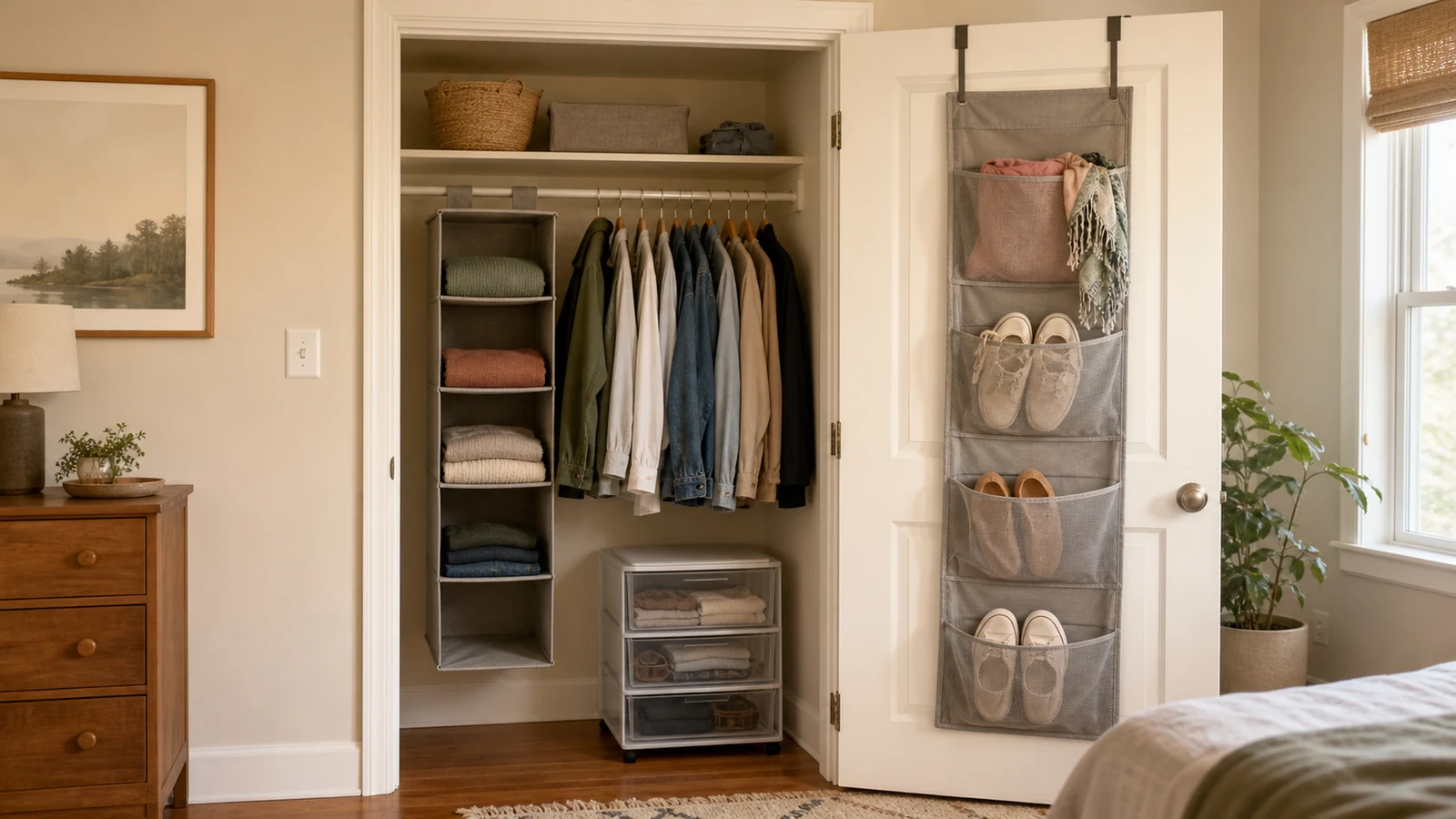
A tiny rental closet often gives you one shelf, one rod and no permission to change either. The usual advice is to “use vertical space,” but that can create a second problem: organizers that block the door, overload the rod or turn folded clothes into a leaning tower.
Measure the unused zones before choosing an organizer. Add storage only where a removable product will not make the closet harder to use.
Measure the door, rod, shelf and floor. Give each zone one job. Then add the smallest reversible product that fixes the specific bottleneck.
The short answer
Start with five measurements: the clear door opening, the door’s top and side clearance, the usable rod height, the existing shelf dimensions and the open floor footprint. Also note where hanging clothes end. A drawer unit that technically fits under the rod may still be useless if coats cover every drawer.
Then choose by the empty zone:
- use a hanging shelf when folded clothes need a home and you can spare rod width;
- use the back of a compatible hinged door for shoes or light accessories;
- use dividers when the existing shelf is large enough but stacks collapse;
- use low drawers when the closet floor is open and the drawers can extend fully;
- move overflow outside the closet on a freestanding rack when the closet itself has no workable space left.
Do not start with adhesive shelves, an improvised tension rod or a tall unanchored tower. “No drill” does not automatically mean low risk.
Clear one zone before buying anything
Remove everything from the closet and sort it into hanging clothes, folded clothes, shoes, accessories, seasonal items and things that belong elsewhere. You do not need a dramatic purge. Sorting shows whether the real shortage is rod space, shelf control, floor storage or simple overcapacity.
Put frequently worn items back first. Move off-season clothing to a labeled bin under the bed or another appropriate storage area if one is available. Empty hangers, donation items and duplicate bags should not decide which organizer you buy.
A small closet usually improves more when one category leaves than when five products arrive.
Measure the closet in use
Door and opening
Measure the narrowest clear opening, not just the door slab. Check the top gap between the door and frame with the door fully open and nearly closed. Door clearance must allow the hooks to pass through that gap without scraping, preventing the latch from working or forcing the hinges.
If the door folds, slides, mirrors another panel or has little top clearance, treat over-door storage as unavailable unless the product documents compatibility. Do not assume a standard hinged-door organizer will work.
A cardboard template helps. Cut or fold a piece to the organizer’s published width, height and loaded depth. Tape it temporarily with painter’s tape that is suitable for the surface, then open and close the door slowly. The template will show whether it hits the wall, clothes, handle or floor before you bring a product home.
Rod
Measure from the rod to the floor and from the rod to the bottom of your shortest hanging items. Record how much horizontal rod width you can give up.
A hanging shelf adds compartments by consuming hanging space. That is useful only when folded storage is the larger problem. Remember that the organizer’s stated capacity does not establish the capacity of the landlord’s rod, brackets or shelf. The total load includes the organizer and everything placed inside it.
Existing shelf
Measure width, depth, thickness and the shape of the front edge. Clip-on dividers and under-shelf products are not universal. A shelf with a thick face, rounded edge or closely spaced wire may not accept an anchor designed for a flat panel.
Also measure the vertical space above the shelf. A divider cannot stabilize a stack that is already too tall to remove safely.
Floor
Measure clear width and depth at floor level, including baseboards. Then measure from the floor to the bottom of the hanging clothes. Open the closet door and note how much space a drawer needs to pull out.
Do not stop at the product’s cabinet dimensions. Casters, handles and fully extended drawers all need room.
Compare the five useful mechanisms
A rod-hung shelf converts hanging width into folded storage. It is fast to install and easy to move, but it can sag when overloaded and may leave no room for long clothes.
An over-door organizer uses a surface that might otherwise be empty. It can keep shoes and small accessories visible, but it adds thickness to the door and transfers the loaded weight to the door and hinges.
Shelf dividers do not create a new shelf. They make an existing shelf easier to use by keeping short stacks upright. They are a poor match for heavy objects or an incompatible shelf edge.
A low drawer cart uses floor space and keeps small clothing visible. It works only when hanging clothes, the door and baseboards leave enough operating clearance.
A freestanding rack does not improve the closet interior. It moves selected overflow into the room, laundry area or another measured zone. That can be the most honest answer when the closet has reached its usable limit.
Five documented products for different constraints
Disclosure: This research-led guide includes direct retailer links and optional Amazon search links. We did not physically test these products; specifications and availability were checked against current first-party pages on July 29, 2026.
Hanging shelves: Brightroom 6-Shelf Hanging Fabric Storage Organizer
May suit: a closet with enough height and 14 inches of rod width to trade for folded storage.
Target’s current exact product page describes the six-shelf version as 54 inches high with a 30-pound capacity. The organizer takes 14 inches of hanging width, uses fabric and metal, and includes an accessory hook on each side. It was available for pickup and shipping when checked.
That 54-inch drop is the deciding measurement. In a closet with a standard-height rod, it may reach close to the floor. In a closet filled with dresses and coats, giving up 14 inches of rod can make the hanging problem worse.
Use it for folded sweaters, jeans, soft accessories or light shoes rather than dense stacks. Keep the total below the product limit and any lower limit that applies to the existing rod.
Door storage: Brightroom Over-the-Door 26-Shelf Mesh Shoe Organizer
May suit: a standard hinged closet door with enough top clearance, 22 inches of free width and room for a loaded organizer to project into the closet or room.
The product page lists overall dimensions of 67 inches high, 22 inches wide and 6 inches deep. It has 26 mesh compartments intended for 13 pairs of shoes, a 25-pound total capacity and no assembly requirement. Target showed it in stock when checked.
The page does not publish a maximum compatible door thickness. That missing measurement matters. Buy only if the hooks fit the actual door without forcing it, and return the organizer if the door scrapes, will not latch or shifts on its hinges.
Use the lower pockets for heavier shoes and the upper pockets for light accessories. Do not treat every pocket as permission to load a dense object.
- View the exact Brightroom 26-shelf over-door organizer at Target
- Find over-door shoe organizers on Amazon
Existing-shelf control: Brightroom 2-Piece Adjustable Shelf Dividers
May suit: a flat, compatible shelf where folded stacks or soft bins fall sideways.
Target lists the set at 10.23 inches long, 8.26 inches high and 8.66 inches wide, with a stated capacity of 6 pounds. The recycled-PET dividers have built-in anchors and require no assembly. The page showed pickup and shipping availability when checked.
This is the least space-hungry option in the shortlist, but the anchor fit is critical. Measure the shelf edge and inspect the divider’s attachment shape before removing packaging. “Adjustable” does not mean it fits every wood, laminate or wire shelf.
Use dividers to keep modest folded stacks upright. They are not bookends for heavy bags, appliances or a high stack that could fall when pulled.
Floor drawers: Brightroom 3-Drawer Wide Storage Cart
May suit: a closet with an open floor rectangle at least 21 7/8 inches wide and 15 3/8 inches deep, plus room to open the drawers.
The cart is 24 1/2 inches high without casters and 26 1/8 inches high with them. Its three clear drawers have interior bottoms measuring 13 1/8 by 19 1/8 by 7 1/8 inches. Target describes it for lightweight items and does not publish a numeric per-drawer limit.
That missing load limit is a reason to use restraint, not guesswork. Folded shirts, workout clothes, socks or linens are more sensible than books or dense hardware. Put the heaviest clothing in the bottom drawer and keep the cart on a level floor.
The checked page offered local pickup but not shipping, so availability may depend on location.
Move overflow outside: IKEA MULIG Clothes Rack
May suit: a closet that is already full but a bedroom, laundry area or sheltered adjacent space has a clear 39-by-18 1/8-inch floor zone.
IKEA lists the MULIG rack at 39 inches wide, 18 1/8 inches deep and 59 7/8 inches high, with a 44-pound maximum load. It is steel, has adjustable feet for uneven floors and was listed in stock when checked.
This is not a tiny product, and it should not be squeezed into a walking path just because it is inexpensive or moveable. Use it for a deliberately limited group such as work clothes, tomorrow’s outfits or a seasonal capsule. Spread weight across the bar, tighten the assembly as instructed and recheck stability after loading.
If children live in or visit the home, do not allow climbing or pulling. CPSC warns that unsecured furniture can create tip-over hazards and says to follow manufacturer instructions for securing furniture. If any storage product requires wall anchoring, renter status is not a reason to skip that requirement.
Treat adhesive storage as a low-load exception
Adhesive hooks can be useful for a belt, scarf or other light accessory, but the wall finish and removal method matter as much as the package capacity.
Command’s official instructions say not to use its hooks on wallpaper. The brand directs users to clean approved surfaces with rubbing alcohol, press the product as instructed and wait one hour before loading. For removal, it says never pull the strip toward yourself; pull straight down and stretch slowly against the wall by at least 12 inches.
Follow the exact product’s surface and weight instructions. Check the lease, test an inconspicuous area when appropriate and avoid hanging anything fragile, valuable or dangerous if it falls. A “damage-free” marketing phrase is not a guarantee for unknown paint, poorly bonded layers or incorrect removal.
What to skip
Skip an improvised second rod made from a curtain tension rod unless its manufacturer explicitly documents the intended clothing load and compatible surfaces. A rod staying in place while empty does not prove it will hold a row of garments.
Skip tall narrow drawers, cubes or shelving when the instructions require wall anchoring and drilling is not approved. Choose a lower format or ask the property owner for written permission to install the required restraint.
Skip an over-door organizer when the door rubs, will not latch or cannot open fully. Storage is not an improvement if it damages the frame or blocks access.
Skip matching bins until you know what each one will hold. Containers consume space too. A bin without a retrieval job often becomes another place to lose small items.
Skip loading the top shelf with heavy objects that are hard to lift safely. Use a stable step stool when needed, and keep everyday items within comfortable reach.
Set up one zone for a week
Choose the single worst bottleneck. Install one reversible method, load it conservatively and live with it for seven days.
Watch for friction:
- Does the door still open and latch normally?
- Can you remove one item without unloading a whole stack?
- Does a hanging organizer crowd the clothes beside it?
- Do drawers open fully with clothes hanging above them?
- Does the rod, shelf or organizer bend, shift or creak?
- Can every household member reach the items they use?
If the setup fails one of those checks, change it before adding another product. A small closet needs breathing room more than it needs a complete “system.”
Frequently asked questions
What is the easiest no-drill way to add closet shelves?
A fabric organizer that hangs from the existing rod is usually the simplest reversible shelf format. Measure the rod width it consumes, the full hanging drop and the loaded capacity before buying. It will not help if hanging space is already the main shortage.
Are over-the-door organizers safe for every closet door?
No. Door thickness, top clearance, hinge strength, handle position and the loaded depth all vary. Use the exact product dimensions, test the door through its full swing and stop if it scrapes or will not latch.
Can I use a tension rod as a second closet rod?
Only when the manufacturer explicitly approves the intended use, load and contact surfaces. Curtain-rod ratings should not be assumed to cover clothing storage.
Do removable adhesive hooks damage rental walls?
They can reduce drilling, but results depend on the approved surface, paint condition, preparation, load and removal technique. Follow the exact manufacturer instructions and your lease. Do not use them on a surface the manufacturer excludes.
What if nothing else fits inside the closet?
Move one controlled category outside it. A measured freestanding rack, under-bed bin or existing dresser may be more useful than forcing another organizer into a closet that no longer functions.
Our research approach
This is a research-led comparison, not a hands-on product test. We started with a recurring renter problem documented across independent current sources, compared removable storage mechanisms, and then checked exact dimensions, materials, load statements and availability on first-party Target and IKEA pages.
We excluded products that were sold out, lacked enough compatibility information for their role, required drilling or wall anchoring for safe use, or duplicated another mechanism without adding a clear benefit. Product pages and availability can change; re-measure and read the current instructions before purchasing.
Sources
- U.S. Consumer Product Safety Commission: AnchorIt.gov
- Command Brand: How to apply and remove hooks, ledges and caddies
- Brightroom 6-Shelf Hanging Fabric Storage Organizer
- Brightroom Over-the-Door 26-Shelf Mesh Shoe Organizer
- Brightroom 2-Piece Adjustable Shelf Dividers
- Brightroom 3-Drawer Wide Storage Cart
- IKEA MULIG Clothes Rack
Related guidance
Continue with the Well Walked Finds Home Organization hub. For shoes near the door, use our small-entryway shoe-storage guide. The same measure-first approach can help with organizing deep pantry shelves and working around pipes under a sink.