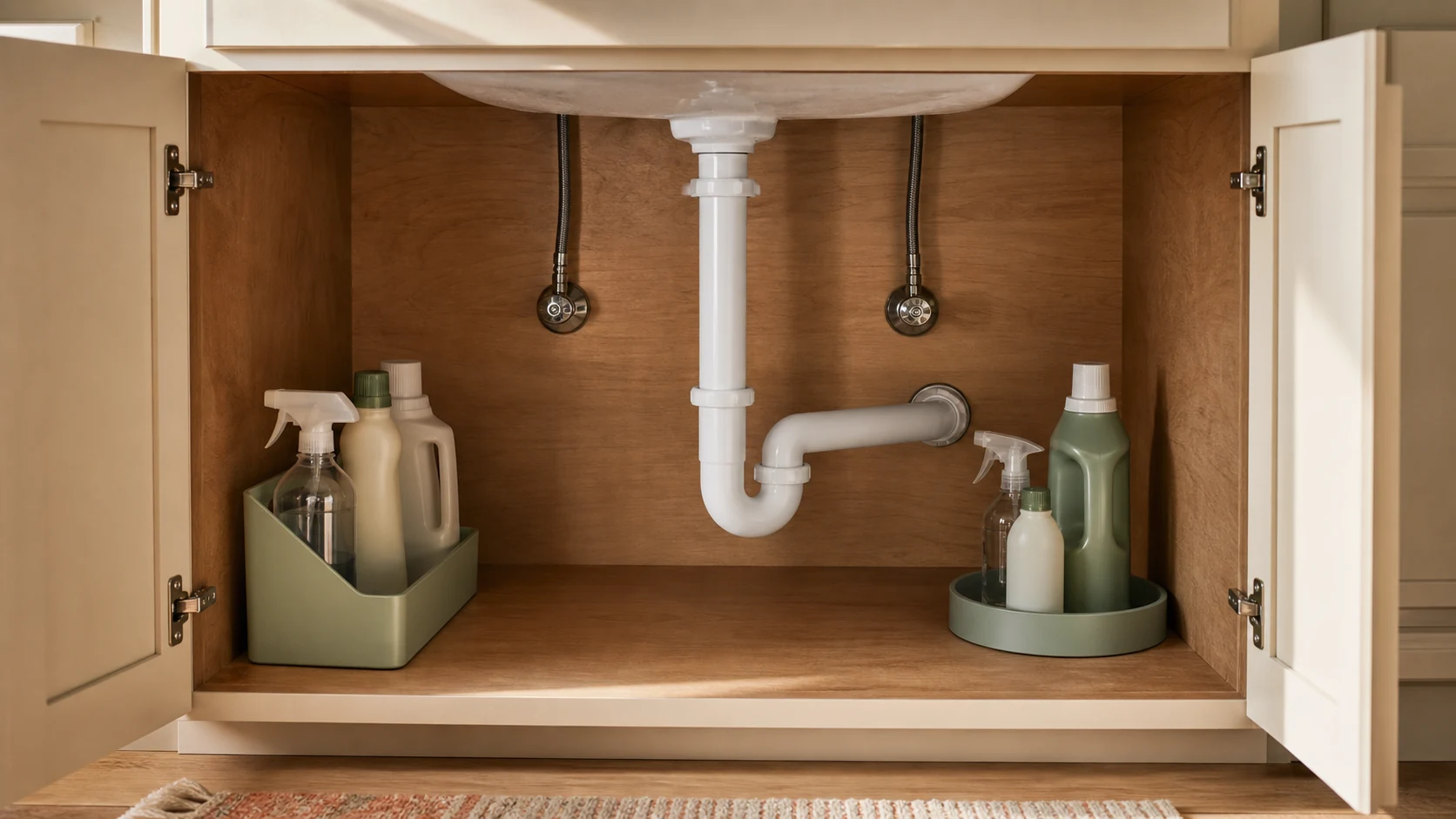
The fastest way to waste money under a sink is to measure the cabinet wall to wall, buy a popular two-tier organizer, and discover that the drainpipe runs through the middle of it.
Under-sink cabinets are not empty boxes. The P-trap hangs down. Supply lines and shutoff valves need to stay reachable. A garbage disposal may take most of one side. Hinges steal room near the opening. Then there are the things already stored there: spray bottles, dishwasher pods, sponges, trash bags and backups.
A workable setup starts with the plumbing, not the organizer. Map the obstacles, protect the cabinet floor, and give everyday supplies a clear route out.
The short answer
Empty the cabinet and check for moisture first. Measure the usable door opening, interior depth and the clear spaces on each side of the plumbing. Keep shutoff valves visible and reachable. Then choose one or two small organizers that fit those clear zones.
For most cabinets, that means a narrow rolling caddy on one side, a turntable only where a full 12-inch footprint is clear, or a simple shelf in an unobstructed side bay. A raised-edge mat can make spills easier to see and clean, but it is not a repair for a leak.
Start with an empty, dry cabinet
Take everything out, including loose shelf liner. Look at the pipe connections, cabinet seams and floor.
EPA WaterSense recommends listening for drips and checking under sinks for leaks at pipe connections, puddling and water spots. If you find active moisture, fix the source and let the cabinet dry before covering the floor or loading supplies back in. An organizer can hide a slow leak surprisingly well.
Sort what came out into four groups:
- products used every week;
- refills and backups;
- trash and recycling supplies;
- items that belong somewhere else.
Dispose of products according to their labels and local rules. Do not combine partly used cleaners to save space.
Poison Control advises keeping household cleaners in their original labeled containers, away from food and medication, and in cabinets with child-resistant latches when children can reach them. A pretty refill bottle is not an upgrade if it removes the original safety label.
Measure the cabinet as it actually works
Use a tape measure and write down these numbers before shopping:
- Usable door-opening width. Measure the narrowest clear opening, not just the inside wall-to-wall width.
- Interior depth with the door closed. Subtract the space taken by hinges, door hardware and anything mounted on the door.
- Interior height. Measure to the lowest pipe, sink bowl or disposal, not only to the cabinet ceiling.
- Clear floor zones. Record the width and depth of each uninterrupted patch on the left, right and front of the plumbing.
- Pipe and disposal positions. Note how far they sit from the back, sides and floor.
- Access space. Leave a hand-width route to each shutoff valve and enough room to see the pipe connections.
A piece of painter’s tape on the cabinet floor can help you test an organizer’s footprint. Mark the proposed width and depth, close the door, and make sure hinges and stored bottles do not cross the outline.
Quick measurement worksheet
- Door opening: _____ W x _____ H
- Usable interior: _____ W x _____ D x _____ H
- Clear space left of plumbing: _____ W x _____ D
- Clear space right of plumbing: _____ W x _____ D
- Lowest obstruction above floor: _____ H
- Maximum safe depth with door closed: _____
- Shutoff valves remain visible and reachable: yes / no
If the last answer is no, change the layout.
Choose a layout by obstacle
A centered P-trap
Do not try to bridge the whole cabinet unless a shelf is specifically designed for your pipe positions. Two smaller zones are usually easier: a narrow caddy on one side and low bins or a compact shelf on the other.
Keep the center open enough to inspect the trap and connections. Store frequently used bottles near the front. Backups can move to a pantry, laundry area or higher shelf if the cabinet is crowded.
A garbage disposal on one side
Treat the disposal side as a service zone. Avoid packing products against the unit, cord or plumbing. Use the opposite side for the main organizer.
A narrow caddy works well here because the entire group can roll or lift out when a plumber needs access. Measure depth carefully; handles and hanging baskets can extend farther than the organizer body.
A low trap or crowded plumbing
Skip the tall two-tier unit. Use low trays, shallow bins or a turntable only if its full circular footprint clears the pipes. Vertical storage is useful only when the plumbing leaves real vertical space.
A wide, clear side bay
A simple shelf can use the unused height above short items. It does not need to span the cabinet. A shelf placed completely beside the pipes is easier to fit and remove than a large structure built around them.
Four documented examples, each for a different job
These products were researched from current manufacturer information on July 26, 2026. We have not physically tested them. Prices and availability can change, so measure first and recheck the destination before buying.
Narrow movable caddy: YouCopia RollOut Under Sink Caddy, 8-inch
The RollOut is 7.7 inches wide, 5.3 inches high and 16.4 inches deep. Its optional hanging basket extends the total depth to 21.3 inches. YouCopia states that it holds up to 30 pounds and requires no tools.
Best fit: a narrow, clear lane beside a P-trap or disposal. Check first: closed-door depth, hinge swing and whether the basket makes it too deep. Price snapshot: $29.99. Manufacturer details: https://youcopia.com/products/rollout-under-sink-caddy
Turntable: YouCopia SinkSuite Under Sink Turntable
The SinkSuite measures 12 inches wide by 12 inches deep and 3.3 inches high. It has removable dividers, non-slip feet and a manufacturer-stated 30-pound capacity.
Best fit: a clear 12-inch square beside the plumbing, especially for frequently used bottles. Check first: the turntable and the tallest bottle must rotate without hitting a pipe or cabinet wall. Price snapshot: $24.99. Manufacturer details: https://youcopia.com/products/sinksuite-under-sink-turntable
Side-bay shelf: YouCopia UpSpace Adjustable Shelf
This shelf measures 16 inches wide, 9 inches deep and 7.7 inches high. Its clearance adjusts from 3.7 to 5.7 inches, and YouCopia states that the steel-and-plastic shelf supports up to 25 pounds.
Best fit: a clear 16-by-9-inch patch completely beside the pipes. Check first: this is not an around-pipe shelf. It will not solve a centered obstruction. Price snapshot: $19.99. Manufacturer details: https://youcopia.com/products/upspace-adjustable-shelf
Raised-edge floor protection: SMARTLINER HOME Under Sink Cabinet Mat
Smartliner lists multiple cabinet sizes, including 22.5 by 28.5 inches and 22.5 by 34.5 inches. The manufacturer describes the mats as waterproof, with raised edges, and says they can be wiped or rinsed clean.
Best fit: a cabinet floor that matches one of the listed sizes. Check first: measure the actual interior floor. A nominal 30- or 36-inch cabinet does not guarantee that the corresponding mat will fit around hinges or plumbing penetrations. Price snapshot: starting at $42.49. Manufacturer details: https://www.smartliner-usa.com/products/smartliner-under-sink-cabinet-mats
A mat can contain a limited spill and make cleanup easier. It cannot diagnose a leak, and it should not make pipe connections harder to inspect.
What not to buy yet
Hold off if any of these apply:
- the organizer’s listing does not give full exterior dimensions;
- only the cabinet width was measured;
- the lower drawer runs into a pipe or disposal;
- the organizer blocks a shutoff valve;
- a door-mounted caddy has no documented load limit or approved mounting surface;
- the product would force household chemicals into unmarked containers;
- the seller, brand or replacement parts are unclear.
Large two-tier pullouts can be useful in open cabinets, but they are a poor default under a sink. The bottom tier may fit while the upper frame hits the trap, disposal or sink bowl. Product photos taken in empty demonstration cabinets rarely show the same plumbing geometry you have at home.
A setup that stays usable
Put the cabinet back together in this order:
- Place the measured floor mat or tray, if using one.
- Keep the plumbing center and shutoff path clear.
- Install or place the largest organizer in its taped footprint.
- Load only the weekly-use supplies.
- Add backups only if they remain visible and easy to remove.
- Close the door slowly and check hinges, bottles and handles.
- Pull every organizer out once. If removal is awkward while empty, it will be worse when loaded.
Group products by task rather than bottle height alone. A small caddy for dishwashing supplies is easier to lift out than a row of unrelated bottles. Keep heavy refills low. Store wipes and sponges where they can dry according to their care instructions.
Check the cabinet periodically. EPA WaterSense recommends regular leak checks, and a quick look at pipe connections and the cabinet floor takes less time when the layout is not packed solid.
Frequently asked questions
Can I put a shelf directly under the P-trap?
Only if the shelf clears the trap with room to remove it and does not hide connections or shutoff valves. A shelf beside the plumbing is usually simpler.
Is a turntable better than a pullout drawer?
A turntable needs a clear circular footprint. A narrow pullout needs a clear lane and enough door depth. The better choice is the one that fits your cabinet’s open space and can be removed without disturbing the plumbing.
Should cleaning products stay under the kitchen sink?
Only if the cabinet can be secured from children and the products remain in their original labeled containers. If that is not possible, move them to a safer locked location away from food and medication.
Will an under-sink mat stop water damage?
It may contain a limited spill, depending on its size and edge height. It will not stop or repair a leak. Check the cabinet and plumbing rather than relying on the mat as a warning system.
How often should I check for leaks?
EPA WaterSense recommends regularly checking the home for leaks and addressing them promptly. A practical habit is to look at pipe connections and the cabinet floor whenever you replace a frequently used product or clean the cabinet.
Our research approach
We compared each example by documented footprint, access method, installation requirements and manufacturer-stated capacity. We favored products that solve different layout problems rather than listing several versions of the same two-tier drawer. We rejected unofficial look-alike sites and generic marketplace listings with unclear specifications.
Well Walked Finds has not physically tested these products. Recheck current dimensions, availability and seller details before purchasing.
Sources
- Poison Control, container transfers and safe cleaner storage: https://www.poison.org/articles/container-transfers
- EPA WaterSense, home maintenance and under-sink leak checks: https://www.epa.gov/watersense/home-maintenance
- EPA WaterSense, leak-detection and flow-monitoring devices: https://www.epa.gov/watersense/leak-detection-and-flow-monitoring-devices
- YouCopia RollOut Under Sink Caddy: https://youcopia.com/products/rollout-under-sink-caddy
- YouCopia SinkSuite Under Sink Turntable: https://youcopia.com/products/sinksuite-under-sink-turntable
- YouCopia UpSpace Adjustable Shelf: https://youcopia.com/products/upspace-adjustable-shelf
- Smartliner Under Sink Cabinet Mats: https://www.smartliner-usa.com/products/smartliner-under-sink-cabinet-mats