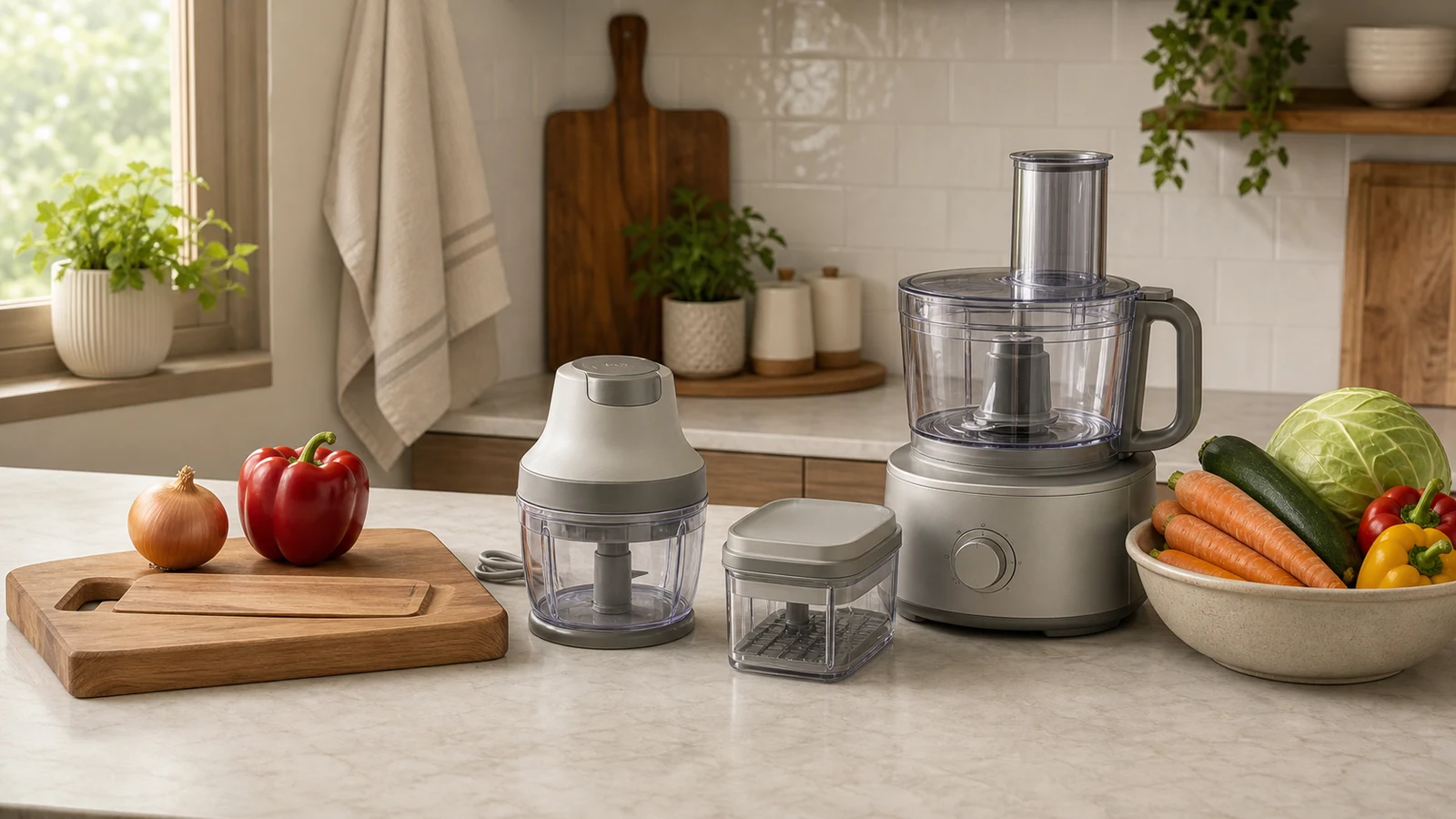
A vegetable-prep tool saves time only when it makes the cut you need and does not create a bigger washing job. A full food processor is excessive for half an onion. A small chopper can turn cabbage into confetti when the recipe needs long shreds. A grid cutter makes tidy cubes but still asks you to trim the food first.
Start with three questions: How much are you cutting? What shape does the recipe require? How many parts are you willing to wash?
The answer may be a tool you already own.
The short answer
Use a stable cutting board and a suitable sharp knife for one or two vegetables, mixed shapes, or a job that would finish before an appliance is assembled.
Consider a manual grid chopper when you want repeatable dice or long cuts and have enough food to justify cleaning the grid. Choose an upright mandoline when the job is repeated slices, julienne strips, or a specific thickness. Use a compact electric chopper for small batches where coarse-to-fine texture matters more than exact shape. Save a full-size food processor for larger chopping, slicing, or shredding sessions.
Count setup, preliminary trimming, blade changes, washing, drying, and storage as part of the job. “Dishwasher-safe” is helpful, but it does not make sharp parts handle themselves.
Choose the cut before the machine
A recipe that says “chop” may tolerate uneven pieces. A salsa or soup starter may benefit from similar dice. Coleslaw needs shreds, not tiny chopped fragments. A gratin needs slices of consistent thickness. Pesto needs a controlled coarse-to-fine texture.
Those are different jobs.
Powered chopping blades spin through food. They are useful for changing texture, but they do not automatically create neat cubes or long strips. A grid forces food through fixed openings, so it can create repeatable dice. A slicing disc or mandoline makes repeated passes at a set thickness.
Write down the required result before looking at products. This prevents buying a fast mechanism that makes the wrong cut.
Use total time, not motor time
A tool’s processing time is only one part of vegetable prep. Compare the complete sequence:
- retrieve and assemble the tool;
- wash, peel, and trim the produce;
- make the cut;
- transfer the food;
- disassemble and clean every food-contact part;
- dry and store the tool.
For a small job, a knife and board often have the shortest sequence. As the batch grows or the cut becomes repetitive, a specialized mechanism can earn back its setup and cleanup.
Run a dry setup test before buying. Identify where the tool will live, where its sharp parts will be stored, and whether the bowl, grid, or attachments fit your sink or dishwasher. A tool stored behind heavy appliances may be too inconvenient to become a time-saver.
Start with a stable board and the knife you already use
Best for: one or two vegetables, irregular chunks, mixed cuts, and small jobs.
The lowest-friction option is often a suitable sharp knife on a board that does not move. There is no motor base, collection bin, feed tube, or grid to assemble. The same knife can switch from an onion to herbs to a pepper without changing attachments.
This is not a recommendation to rush or copy advanced knife techniques. Use a cutting method that suits your control and comfort. If grip, hand strength, vision, or dexterity makes knife work difficult, choose a mechanism that reduces the motion rather than forcing speed.
A sliding or warped board cancels the convenience. Stabilize it with a method appropriate to the board and counter, and stop if it rocks or shifts. Replace a board with deep, hard-to-clean grooves.
Four documented tools for different batches
Disclosure: This is a research-led guide, not a hands-on product test. Well Walked Finds did not physically test these products. We checked specifications, instructions, and current first-party destination status on July 30, 2026.
For repeatable dice: Cuisinart PrepExpress Vegetable & Fruit Chopper
May suit: soup starters, potatoes, peppers, onions, or other batches where uniform dice or long cuts matter.
Cuisinart documents interchangeable small and large stainless-steel blade grids, an angled chopping platform, and a nonslip 4-cup collection container. The set includes a cover and cleaning tool. Its published footprint is 10.24 inches long, 5.75 inches wide, and 4.92 inches high.
This is not a drop-in shortcut for every whole vegetable. The manual says to trim ingredients to fit, avoid overloading the cutting surface, and take particular care with harder foods such as carrots. That preliminary work belongs in your time comparison.
The blade grids are sharp. Cuisinart instructs users to handle a grid by its frame, lock it into position, place both hands on top of the lid, and keep hands and utensils away from the blades. Remove the grid before cleaning the lid guides and use the supplied cleaning tool for trapped food.
Choose this mechanism for the shape it makes, not because the word “chopper” sounds universal.
For repeated slices and julienne cuts: Cuisinart PrecisionSlice Upright Mandoline
May suit: potatoes, cucumbers, zucchini, carrots, and similar produce when repeated thickness or cut style matters.
This mandoline works in an upright, gravity-fed position rather than asking the hand to travel across a flat blade deck. Cuisinart lists 40 thickness settings from 1 to 8 millimeters and cutting modes for slices, dice, and thin or thick julienne strips. It includes a food pusher, collection container, and cleaning brush.
The unit is 4.53 inches long, 5.47 inches wide, and 11.73 inches high. It folds for storage, has suction feet, and is listed as top-rack dishwasher-safe.
The upright design is intended to keep hands away from the double-sharpened blades, but it does not make them harmless. Use the supplied pusher and cleaning brush. Keep fingers out of the feed path and follow the current instructions for assembly and cleaning.
Choose it when consistent slices or strips are the actual goal. For one tomato or a rough-cut stew, its settings and cleanup may add more work than they remove.
For a small coarse-to-fine batch: KitchenAid 3.5 Cup Food Chopper
May suit: herbs, garlic, salsa ingredients, soup bases, sauces, or other small batches where texture matters more than exact shape.
KitchenAid documents a 3.5-cup work bowl with a handle and pour spout, a locking stainless-steel multipurpose blade, and a lid with a drizzle basin. Two speeds and a pulse control move results from coarse to fine. The work bowl, lid, and blade are listed as dishwasher-safe, and the base has a cord wrap.
This product chops, mixes, and purées. It does not include a slicing or shredding disc, so it is the wrong mechanism for long cabbage shreds or identical rounds. Pulse and inspect the texture instead of assuming a “chop” button knows the recipe’s intended shape.
A compact bowl lowers the storage burden compared with a full processor, but repeated loads can erase that advantage. If the planned batch exceeds one comfortable load, compare the full sequence with a larger machine.
Unplug powered equipment before assembly, disassembly, or hands-on cleaning. Handle the locking blade as a sharp part even when it is headed to the dishwasher.
For large slicing, shredding, or chopping sessions: Cuisinart Custom 14 Cup Food Processor
May suit: family-size or batch-prep sessions with enough volume to justify a heavier base and several food-contact parts.
Cuisinart lists a 14-cup work bowl, 720-watt motor, chopping and mixing blade, 4-millimeter slicing disc, medium shredding disc, and large and small feed tubes with pushers. The machine measures 11 inches long, 7.9 inches wide, and 14.8 inches high, and weighs 15.7 pounds. All parts except the motor base are listed as dishwasher-safe.
The bowl name is not the capacity for every task. The instruction manual lists up to 14 cups for sliced or shredded fruit, cheese, or vegetables, but only 3 cups for chopped or puréed fruit and vegetables. Use the current manual and marked fill limits for the selected operation.
That difference matters. A large processor earns its space when its feed tube and discs remove a long series of repeated cuts. It is rarely the rational choice for one onion if lifting, assembly, blade handling, washing, and storage are counted.
The manual says to use the pusher rather than a hand for food in the feed tube, keep hands and utensils away from moving blades, wait for the motor to stop before removing the cover, and unplug before assembly, disassembly, or cleaning. The base must not go in water.
Match the tool to five common jobs
One onion and one pepper for dinner
Start with the knife and stable board. A grid chopper can make even dice, but trimming the pieces and cleaning the grid may take longer than the small job.
A large container of soup-starting vegetables
Use the grid chopper when uniform dice are useful and the produce suits its documented cutting guide. Use a processor when shape is less important and the batch fits the manual’s chopping limit. Do not infer capacity from the bowl name alone.
Cabbage or carrots for slaw
Choose a mechanism that makes shreds or julienne strips. A compact chopping blade can reduce the food to small fragments instead. An upright mandoline or a full processor with the appropriate shredding disc is the better match.
Repeated potato or zucchini slices
A thickness-adjustable slicer removes repeated measuring and can make more consistent rounds. The upright mandoline is the smaller dedicated option. The full processor makes more sense when the batch is large enough to justify the extra parts.
Herbs, garlic, or a small sauce base
A compact electric chopper can control a coarse-to-fine texture without bringing out a full-size processor. Stop and inspect between pulses so the bottom does not become paste while larger pieces remain above.
Account for hand strength and access
A manual grid chopper replaces repeated knife strokes with downward pressure. That may help one reader and be difficult for another. Hard foods still require force, preliminary trimming, and compliance with the product’s loading instructions.
An upright mandoline keeps hands away from the blade path and uses a spring-loaded handle, but it still requires loading, pressing, disassembly, and safe cleaning. A food processor reduces repeated cutting motions but adds a motor base, locking parts, and sharp attachments.
Check the full motion before buying. Can you lift the product from its storage location, lock every part, operate it without strain, and clean it without reaching near a blade? A tool that solves chopping but creates an unsafe lifting or washing task is not a good fit.
If pain, weakness, tremor, or another condition affects food preparation, advice from an occupational therapist can be more useful than a generic product list.
Wash the produce and the work surface safely
The FDA advises washing hands with warm water and soap before and after preparing fresh produce. Rinse produce before peeling, then rub it under plain running water. The agency says soap or a produce wash is not needed. Use a clean produce brush for firm items and dry them with a clean cloth or paper towel.
Wash cutting boards with hot, soapy water after each use, according to USDA guidance. Rinse and air-dry or dry with clean paper towels. Dishwasher suitability depends on the board material; laminated boards may crack or split. Discard boards that become excessively worn or develop hard-to-clean grooves.
Treat removable blades, grids, discs, and pushers as a complete cleaning system. Follow the exact model instructions. Do not leave a loose sharp part hidden in cloudy sink water or an overloaded dishwasher basket.
Run a one-week usefulness test
Before buying, note the vegetables, batch size, and required cuts for five ordinary meals. Mark which tool would do each job and list every part that would need washing.
A candidate earns cabinet space when the same mechanism solves several recurring jobs without distorting the cut. It does not earn space because it looked fast in a short video.
After purchase, keep the box until the return period ends and test the tool only as directed. Record which meals used it, whether the batch fit in one load, and whether cleanup felt proportionate. If the knife and board still win every comparison, the specialized tool is not saving time in your kitchen.
What to skip
Skip a gadget that does not publish a stable model identity, instructions, dimensions, blade-handling guidance, or replacement support.
Skip a large food processor when it has no reachable storage location. Leaving a 15.7-pound machine in a difficult cabinet can turn every use into a lifting task.
Skip a flat or upright mandoline if the food pusher, guard, or safe cleaning method will not be used. Speed does not justify fingers near an exposed cutting edge.
Skip a grid chopper for oversized hard vegetables unless they are trimmed and loaded according to its instructions. More force is not a substitute for correct preparation.
Skip claims that a tool will save a fixed number of minutes. The result depends on batch size, cut type, storage, dexterity, and cleanup. We did not perform a controlled timing test.
Skip washing whole produce with soap. Follow current FDA guidance for plain running water instead.
Frequently asked questions
Is a vegetable chopper faster than a knife?
It can be for a repeated compatible cut and a batch large enough to repay setup and cleaning. For one or two vegetables, a knife and stable board may finish first. Compare the complete job rather than the chopping motion alone.
What is the best tool for chopping onions and peppers?
Use a knife for a small mixed batch, a grid chopper for repeatable dice, or a food processor when texture matters more than exact cube shape. Check each ingredient against the product’s instructions and do not overload a grid with hard food.
Is a small food chopper the same as a food processor?
Not in capability. The KitchenAid model in this guide uses a multipurpose blade to chop, mix, or purée in a 3.5-cup bowl. The Cuisinart processor adds larger capacity plus dedicated slicing and shredding discs, but it is heavier and creates a larger setup and cleaning job.
Is an upright mandoline safer than a flat mandoline?
The selected Cuisinart model is designed to keep hands away from built-in blades and includes a food pusher and cleaning brush. Those features reduce direct travel across a blade deck, but the blades remain sharp. Safe use still depends on the pusher, assembly, cleaning method, and current instructions.
Should I prep a whole week of vegetables at once?
Only when the produce, recipe, storage, and food-safety plan support it. Cutting in advance can shorten weekday cooking, but not every vegetable keeps the same texture after several days. Keep perishable produce refrigerated at or below 40°F and use current guidance for the specific food.
Our research approach
We started with independently indexed reader questions about time-consuming vegetable cutting and week-ahead prep. We then compared mechanisms by batch size, cut shape, storage burden, cleaning, and blade handling.
We checked the selected models against current first-party product pages and instruction documents. We excluded an OXO grid chopper whose first-party page showed it as out of stock, along with generic marketplace products that offered weaker model, instruction, or seller evidence.
Product pages and availability can change. Read the current manual and verify the exact model before buying.
Sources
- FDA: Seven tips for cleaning fruits and vegetables
- USDA FSIS: Cutting boards
- Cuisinart PrepExpress Vegetable & Fruit Chopper
- Cuisinart PrepExpress instruction booklet
- Cuisinart PrecisionSlice Upright Mandoline
- KitchenAid 3.5 Cup Food Chopper
- Cuisinart Custom 14 Cup Food Processor
- Cuisinart Custom 14 Cup Food Processor instruction booklet
Related guidance
Continue with the Well Walked Finds Kitchen Time-Savers hub. After chopping, use our guide to storing washed vegetables without trapping extra moisture. For shelf-stable ingredients, use our deep-pantry organization guide. The same measurement-first approach helps with working around pipes under a sink.