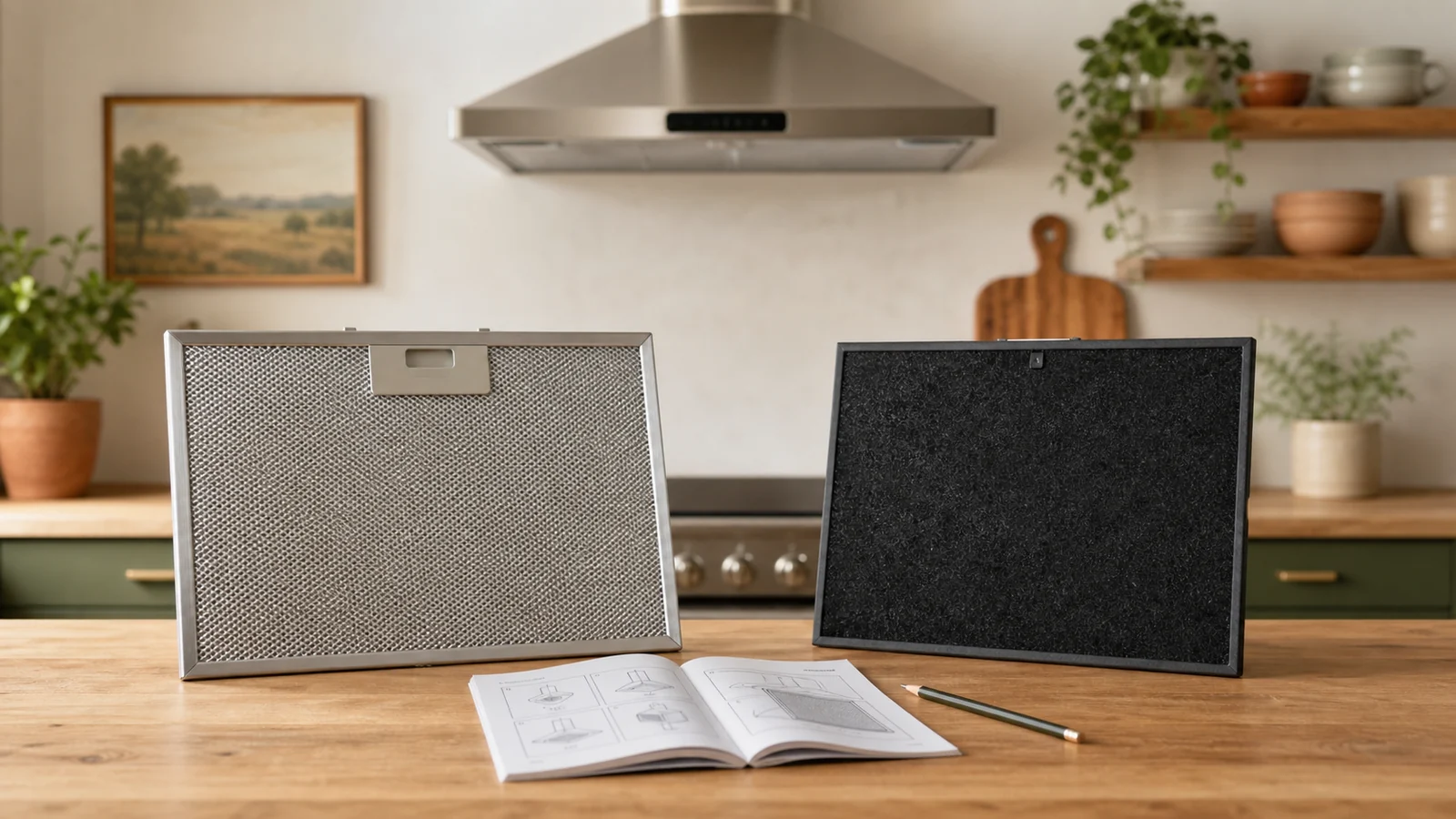
A greasy range hood filter does not automatically belong in a sink or dishwasher. First identify the hood model and the filter type. A reusable metal grease filter may be washable when its manual says so. A charcoal filter in a recirculating hood is often replaced rather than washed.
That distinction matters more than any homemade cleaning recipe. If you cannot confirm the filter type and the manufacturer’s instructions, stop before soaking it.
Quick answer
- Turn the hood off. Follow the manual’s power-disconnection instructions and let the hood and filter cool.
- Find the hood model number and open its current owner manual or manufacturer support page.
- Confirm whether the filter is a removable metal grease filter, a charcoal filter, or a model-specific combination.
- Remove it only by the method shown for that hood.
- Wash a reusable grease filter only with a method the manual approves.
- Replace a non-washable charcoal filter with the exact compatible part specified for the model.
- Let every washable part dry fully, reinstall it correctly, and restore power only as the manual directs.
Do not assume that metal always means dishwasher-safe or that a dark filter is charcoal. The exact manual is the decision point.
Start with the model, not the mess
The filter may be coated with grease, but its condition does not tell you how it should be maintained. Two hoods that look similar can use different filter systems.
Look for the appliance’s model label in the location named by the manufacturer. It may be inside the hood, behind a filter, or on an interior wall. Do not reach into the hood while it is running, while the cooktop is hot, or before completing the power-off steps in the manual.
Use the full model number to find the owner’s manual on the manufacturer’s website. A broad support article can help explain the filter categories, but the model manual controls the removal method, cleaning method, replacement part, and interval.
Before touching the filter, record:
- the full hood model number;
- whether the hood vents outdoors or recirculates air into the room;
- the filter name used in the manual;
- the approved cleaning or replacement instruction;
- any part number listed for a replacement filter;
- the drawing that shows the latch, clips, or release handle.
If the model label is unreadable or the correct manual cannot be found, contact the manufacturer before using a generic method.
Identify the filter path
Removable metal grease filter
A grease filter captures cooking residue before air enters the blower or duct. It may be aluminum mesh, another all-metal design, or a baffle-style filter. Many are reusable, but their care methods are not identical.
Whirlpool’s current vent-hood guidance allows the removable grease filter covered by that guidance to be cleaned in a sink with warm water and detergent or in a dishwasher. A Whirlpool model manual gives the same two choices for its metal grease filter. Broan-NuTone’s support page says removed grease filters can be soaked in warm water with mild detergent, but it also says to consult the owner’s manual before using a dishwasher because only some filters are dishwasher-safe.
The useful rule is narrow: treat a metal grease filter as washable only after the exact instructions confirm the method.
GE Appliances and Bosch publish the same broad split for the filters covered by their support pages. GE says its grease filters can be cleaned with soap and water or in a dishwasher, with possible discoloration, while the charcoal filter cannot be cleaned. Bosch tells owners to turn ventilation off, wash the covered metal filter with warm soapy water and a soft cloth, let it dry thoroughly, and reinstall it. Bosch’s separate charcoal-filter guidance says those filters cannot be cleaned. These examples strengthen the identify-first decision, but they do not make one brand’s method universal.
Charcoal or carbon filter
A recirculating hood commonly uses a charcoal or carbon filter for odor control. It may sit behind a metal filter or attach to it with clips. Removing the visible metal panel does not prove that every layer can be washed together.
Whirlpool says the non-vented charcoal filter in its guidance is not washable and should be replaced as specified in the owner’s manual. Broan-NuTone likewise says its non-ducted carbon filters cannot be washed and must be replaced.
Some appliances may use a different or specialized filter system. Do not use these examples to guess. If the manual identifies a replaceable charcoal filter, keep it out of the sink and dishwasher and use the exact compatible replacement it specifies.
Combination or unfamiliar filter
A hood can have a washable metal grease filter with a separate charcoal layer. Some filters use clips, frames, indicators, or model-specific assemblies. If the manual drawing does not match what you see, stop.
Do not pry apart layers, remove rivets, cut filter material, or order a replacement by dimensions alone. A filter that fits the opening is not necessarily the correct part for the hood.
Prepare a safe work area
Follow the hood manual’s shutdown instructions before cleaning. Whirlpool’s support guidance says to turn the vent hood off and make sure it is cool. A Broan-NuTone model manual goes further for its appliance and calls for disconnecting power before cleaning. Use the instruction written for your model.
Then:
- make sure the cooktop and nearby cookware are cool;
- clear the area below the hood;
- protect the cooktop with a stable towel only after everything is cool and off;
- have a shallow tray ready for a greasy removable filter;
- note the filter’s orientation before taking it out;
- support the filter with both hands so it does not drop onto the cooktop.
Do not spray cleaner upward into the installed hood. Liquid can travel past the filter toward electrical or mechanical parts. Remove only the parts the manual tells the owner to remove.
Clean a washable grease filter
Use this path only after the exact manual confirms that the filter is washable.
1. Remove it by the documented release method
Open the panel, pull the release handle, or disengage the latch exactly as shown in the manual. Keep one hand under the filter. If it will not release with light pressure, recheck the diagram rather than bending the frame.
Place the filter flat in the prepared tray. If a separate charcoal layer is attached, remove or handle it only as the model instructions specify.
2. Choose the approved wash method
For sink cleaning, manufacturer examples support warm or hot water with detergent for their covered metal filters. Broan-NuTone specifies a mild detergent solution in its support guidance. Follow the detergent type, water temperature, soak time, and tool limits in your own manual.
Avoid adding stronger products because the grease looks heavy. Do not use oven cleaner, chlorine bleach, abrasive powder, steel wool, a scouring pad, a pressure washer, or an unlabeled chemical mixture unless the appliance manufacturer explicitly directs it. Those methods can damage a finish, deform a filter, leave residue, or affect adjacent parts.
If the manual permits gentle sink cleaning:
- Fill a basin with the temperature and detergent the manufacturer approves.
- Keep non-washable charcoal material out of the water.
- Let the washable filter sit only for the approved time.
- Move the water through the mesh gently. Do not crush or spread the layers.
- Rinse as the manual directs until detergent residue is gone.
A filter frame can have sharp edges. Handle it by the solid frame rather than pressing fingers into the mesh.
3. Use the dishwasher only when the manual says yes
Dishwasher approval is model- and filter-specific. Broan-NuTone warns that some filters may be dishwasher-safe and tells owners to confirm in the manual. Its support guidance also notes that all-metal filters can discolor under certain detergent or water conditions even when performance is unaffected.
If your exact manual does not mention dishwasher cleaning, that omission is not permission. Use the approved sink method or ask the manufacturer.
4. Dry it fully
Let the filter drain and dry completely in a stable position. Do not reinstall it while water remains in the mesh, frame, latch, or surrounding panel.
Do not speed drying with an oven, cooktop, open flame, or high-heat tool. The filter should return to the hood only when it is cool, dry, undamaged, and correctly oriented.
5. Reinstall and check the fit
Follow the manual’s order for tracks, clips, latches, and panels. The filter should sit securely without a bent frame or forced catch. Restore power only after the hood is fully reassembled as directed.
If the filter will not latch, if the frame is distorted, or if a clip is missing, stop and obtain model-specific service or replacement guidance.
Replace a non-washable charcoal filter
When the manual identifies the charcoal filter as non-washable, cleaning is not the task. Replacement is.
- Find the exact filter or kit named for the complete hood model.
- Compare the manufacturer part number, not just the shape and dimensions.
- Follow the manual’s power-off and removal steps.
- Note which side faces the airflow and how clips or tabs hold it.
- Install the new filter without trimming, compressing, or stacking unofficial material.
- Reinstall the metal grease filter or cover in the documented order.
- Record the replacement date and the model-specific next-check instruction.
Do not rinse, vacuum, bake, sun-dry, scent, or spray a non-washable charcoal filter unless its exact instructions provide a specific care method. A filter can look cleaner while no longer performing as designed.
How often should the filter be cleaned or replaced?
There is no single interval that fits every hood and household. Cooking frequency, cooking methods, filter design, and the manufacturer’s service schedule all matter.
Whirlpool’s covered charcoal-filter guidance says up to six months with normal use. Broan-NuTone publishes different guidance for its filter families and notes that cooking style can change maintenance needs. Those numbers are examples, not a universal calendar.
Use this order:
- follow the interval or indicator in the exact model manual;
- inspect at the frequency the manufacturer recommends;
- service sooner when the manufacturer’s listed condition or indicator calls for it;
- record the date so the next check is based on a real starting point.
Do not wait for a social-media cleaning schedule to override the appliance instructions.
When to stop and get help
Stop the project and contact the manufacturer or a qualified appliance service provider when:
- you cannot identify the full hood model;
- the available manual does not match the installed filter;
- the filter has multiple layers you cannot identify;
- a latch, clip, frame, wire, or panel is damaged;
- the filter will not release without force;
- grease or liquid has reached a part the owner manual does not authorize you to open;
- the hood makes a new noise, will not operate normally, or will not hold the filter securely after reassembly.
This guide covers routine owner-accessible filter decisions. It does not cover motor cleaning, duct cleaning, wiring, internal fan repair, or fire cleanup.
Common mistakes
Washing every filter together
A washable metal filter and a non-washable charcoal layer may be part of the same recirculating setup. Separate them only as the manual directs.
Assuming every metal filter belongs in the dishwasher
Some manufacturer instructions permit it, while others may specify a different method. Confirm the exact model before choosing the dishwasher.
Ordering by size alone
Dimensions can narrow a search, but they do not prove compatibility. Use the hood model and manufacturer part information.
Escalating to a harsh degreaser
A stronger chemical is not automatically safer or more effective for a coated frame, aluminum mesh, nearby finish, or adhesive. Stay within the appliance maker’s cleaning instructions.
Reinstalling a damp filter
Water can remain inside mesh layers and frame channels after the surface looks dry. Give it enough time to dry completely.
Frequently asked questions
Can I wash a charcoal range hood filter?
Not when the model instructions identify it as non-washable. Whirlpool and Broan-NuTone both publish examples of charcoal or carbon filters that must be replaced. Check your exact manual because specialized systems can differ.
Can I put a metal range hood filter in the dishwasher?
Only when the exact manufacturer instructions approve it. Broan-NuTone explicitly tells owners to consult the manual because only some filters are dishwasher-safe.
What if I do not know whether my hood vents outdoors?
Use the model number and installation or owner manual. A visible metal grease filter alone does not reveal the complete configuration because a recirculating hood may use both metal and charcoal filters.
Should I clean the hood while the filter is out?
Clean only the owner-accessible surfaces and only with the method in the manual. Do not spray into the filter opening or reach toward the fan, motor, wiring, or duct.
What if the filter is still greasy after an approved wash?
Do not automatically move to a harsher chemical or more force. Recheck the manual’s method and condition limits, then ask the manufacturer whether the filter should be cleaned again or replaced.
Sources and research note
This is a method-first, noncommercial guide. Well Walked Finds did not physically test the reader’s hood, filter, detergent, or dishwasher. We checked current first-party manufacturer support and model manuals on August 9, 2026. Model-specific instructions take priority over every general step in this article.
- Whirlpool: Cleaning or Replacing the Filters in a Vent Hood
- Whirlpool owner manual W11134239B
- Broan-NuTone: How to Clean Range Hood Grease Filters
- Broan-NuTone: How Often to Clean Filters
- Broan-NuTone Allure QS1 model manual
- Broan-NuTone Range Hood Filter Guide
- GE Appliances: Non-Vented Hood Filter Care
- Bosch: Cleaning a Metal Ventilation Hood Filter
- Bosch: Carbon and Charcoal Filter Care
- Match cleaning methods to cabinet finishes
- Browse Well Walked Finds Cleaning Solutions
- Browse the full Guides library